Text modules don’t have to be simple, you can add personality to them without this being a problem.
All blocks are customizable, add, change and choose the best for your brand.

California and CCPA Compliance Advisory Services
Helping organizations navigate California privacy compliance.
VeraSafe helps organizations navigate California’s privacy laws, including the California Consumer Privacy Act (CCPA) as amended by the California Privacy Rights Act (CPRA), the CCPA regulations, data broker laws, the California Invasion of Privacy Act (CIPA), the California Age-Appropriate Design Code (AADC), the California Customer Records Act, California data breach assessments, and more.
Trusted by leading organizations worldwide:
CCPA Compliance Support
Our privacy attorneys and cybersecurity professionals provide hands-on support for all aspects of compliance with the California Consumer Privacy Act (CCPA), as amended by the California Privacy Rights Act (CPRA), and the implementing regulations. We can help determine whether your organization is subject to the CCPA, conduct a compliance gap analysis, and prepare a remediation roadmap. Related services include:
Data Mapping
We help identify, map, and document all personal information your organization collects, stores, or shares.
Privacy Notice & Transparency
We review and update your privacy notices to align with CCPA transparency requirements, including point-of-collection notice and mobile app disclosures.
Consumer Rights Implementation
We design and implement processes to honor consumer rights under the CCPA, including opt-out requests, Global Privacy Control implementation, authorized agent requests, requests to limit the use of sensitive data, and access, correction, and deletion requests.
Contract Support
We review and renegotiate vendor and third-party agreements to align with CCPA regulatory requirements and help avoid unwanted sales classifications while ensuring vendor cooperation.
Risk Assessments
We conduct and document mandatory privacy risk assessments for high‑risk processing activities, including sensitive personal information and ADMT uses, to meet CCPA regulatory requirements.
ADMT Support
We help businesses that use automated decision‑making technologies provide required pre‑use notices, opt‑out options, and transparent explanations of how decisions are made.
Cybersecurity Audit Readiness
We prepare your organization for independent cybersecurity audits, including program review, documentation, and certification support under the finalized California regulations.
Sensitive Data
We can assess the extent to which your organization collects and processes sensitive personal information (which in California includes precise location and message content), and help manage specific obligations related to such data.
Staff Training
We deliver organization‑wide privacy and security awareness training to help reduce risk, improve compliance practices, and support CCPA workforce education requirements.
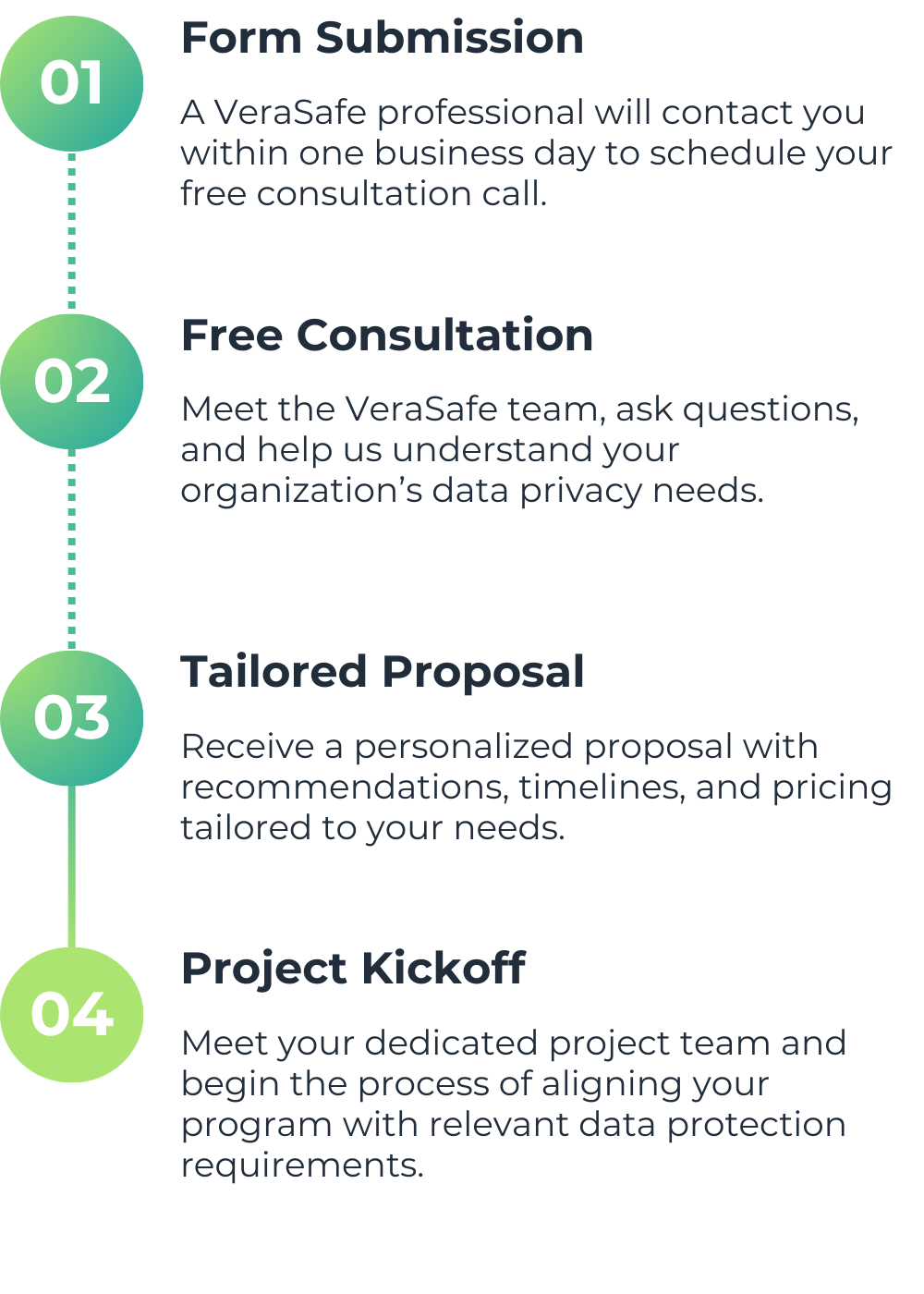
Schedule a Free Consultation
We'd love to learn more about your compliance needs. In this session, a member of our team will tell you more about our program, give you an opportunity to ask questions, and gather any information needed to provide you with a proposal.

The awesome title
Global Privacy Control (GPC) Compliance
GPC is a universal opt‑out signal that lets consumers stop the sale or sharing of their personal information automatically. Businesses subject to the CCPA that may engage in “selling” or “sharing”—such as through the use of online advertising technologies—must honor GPC signals as valid consumer requests and ensure their systems respond accordingly.
How VeraSafe Can Help:
- Work with your web developers and vendors to implement reliable GPC recognition across digital properties.
- Test system functionality to ensure GPC signals are accurately detected and honored.

- Configure tag management or consent management tools to respond properly to GPC signals.

- Update privacy notices and disclosures to reflect support for GPC opt‑out requests.


California Invasion of Privacy Act (CIPA) Compliance Support
Many businesses have received letters from plaintiffs’ attorneys threatening to sue or arbitrate theories related to CIPA. These theories typically focus on the use of website technologies, such as session replay, chatbots, online advertising tools, and cookie banners.
How VeraSafe Can Help:
- Help assess your CIPA risk by examining your website technologies and current cookie banner implementation.
- Recommend options to meet your business’s technological, marketing, and growth objectives while calibrating and balancing CIPA risk and compliance.
- Respond to and resolve demand letters from plaintiffs’ attorneys related to alleged CIPA noncompliance.
Additional California Privacy Support
The privacy law landscape in California grows increasingly complex each year. VeraSafe can identify and support with additional compliance obligations that may be applicable to your businesses, including:
Rules applicable to children and teenagers, including compliance with the California Age-Appropriate Design Code (AADC)
Data broker registration, legal requirements, and Delete Request and Opt-Out Platform (DROP) compliance
California Customer Records Act (aka “Shine the Light”) consumer requests related to marketing disclosures
Data breach assessments, including reporting obligations
Why Choose VeraSafe?
End-to-End Support
From initial risk assessments to ongoing program management, we guide your team through California privacy compliance.
Trusted U.S. Privacy Advisor
We have extensive experience advising organizations of all sizes on state-specific privacy laws and practical implementation strategies.
Technical Fluency
Our team has deep experience integrating Global Privacy Control (GPC) with consent platforms, tag managers, and tracking systems.
Global Perspective
While supporting on California privacy law compliance, we can also help guide your business towards a compliance posture that satisfies other major privacy regimes.
Experienced Team
Our more than 60 team members include American and European attorneys, compliance professionals, and IT security experts with in-depth knowledge of U.S. privacy laws. Our ranks include former regulators and Vault Law 100 attorneys, Certified Information Privacy Professionals (CIPP), Certified Information Systems Auditors (CISA), and alumni of Big 4 professional service firms.

Jim Cormier
Sr. VP and Head of Professional Services
CIPP/E, CIPM, FIP

Kellie Isabel Fernández Del Campo Aguiló
Senior Privacy Advisor
CIPP/E, CIPP/US, CIPM, CIPT, FIP

Joe Hansen
Partner
CIPP/US, CIPP/E

Zia Maharaj
Partner
CIPP/E, CIPP/US, CIPM, FIP, GCP for Clinical Trials (ICH Focus)
Frequently Asked Questions
Which businesses are affected by Global Privacy Control (GPC)?
Under California’s Consumer Privacy Act (CCPA) regulations, a covered business that sells or shares personal information online must treat user‑enabled opt-out preference signals, such as the Global Privacy Control (GPC), as a valid consumer opt‑out request for the sale or sharing of personal information. This includes covered businesses that use commonplace online advertising technologies.
This means that if a business is already subject to the CCPA’s opt‑out requirements because it sells or shares personal information and meets the thresholds of the law, it must read and correctly process GPC signals.
What are the new CCPA cybersecurity audit requirements?
The California Privacy Protection Agency has finalized regulations that require certain businesses to conduct independent annual cybersecurity audits if their processing of personal information presents a significant risk to consumer security. These audits must assess the effectiveness of cybersecurity programs and identify gaps.
What are the new CCPA risk assessment requirements?
Businesses that process personal information in a manner that presents significant risk to consumers’ privacy must conduct risk assessments. This requirement applies to “selling” and “sharing”—a common business activity—as well as processing sensitive data and other circumstances. Businesses must start conducting risk assessments in 2026, and need to submit information about those assessments to the California Privacy Protection Agency no later than April 1, 2028.
What are the ADMT requirements under the updated CCPA regulations?
Under the updated CCPA regulations, businesses that use Automated Decision‑Making Technology (ADMT) to make “significant decisions” about consumers must comply with new transparency and consumer rights obligations, beginning January 1, 2027. These include providing pre‑use notices about ADMT, offering consumers the right to opt out of ADMT processing, and, in some cases, allowing consumers to access information about how automated decisions were made.
When do businesses need to comply with the new cybersecurity audit, risk assessment, and ADMT requirements?
The updated CCPA regulations are effective January 1, 2026, but compliance deadlines are staggered. Cybersecurity audit requirements have phased deadlines, with the earliest audits due by April 1, 2028, for the largest businesses. Businesses need to conduct risk assessments going forward from January 1, 2026, and be prepared to submit required information to the California Privacy Protection Agency no later than April 1, 2028. The ADMT requirements for significant decision‑making are scheduled to begin January 1, 2027.